Changing URLs?
Check the map
before the move.
Collect sitemap URLs. Check what each page does. Use guided prompts to draft a 301 redirect map, then test both sides.
One payment. No VAT. Use on your own sites and client projects.
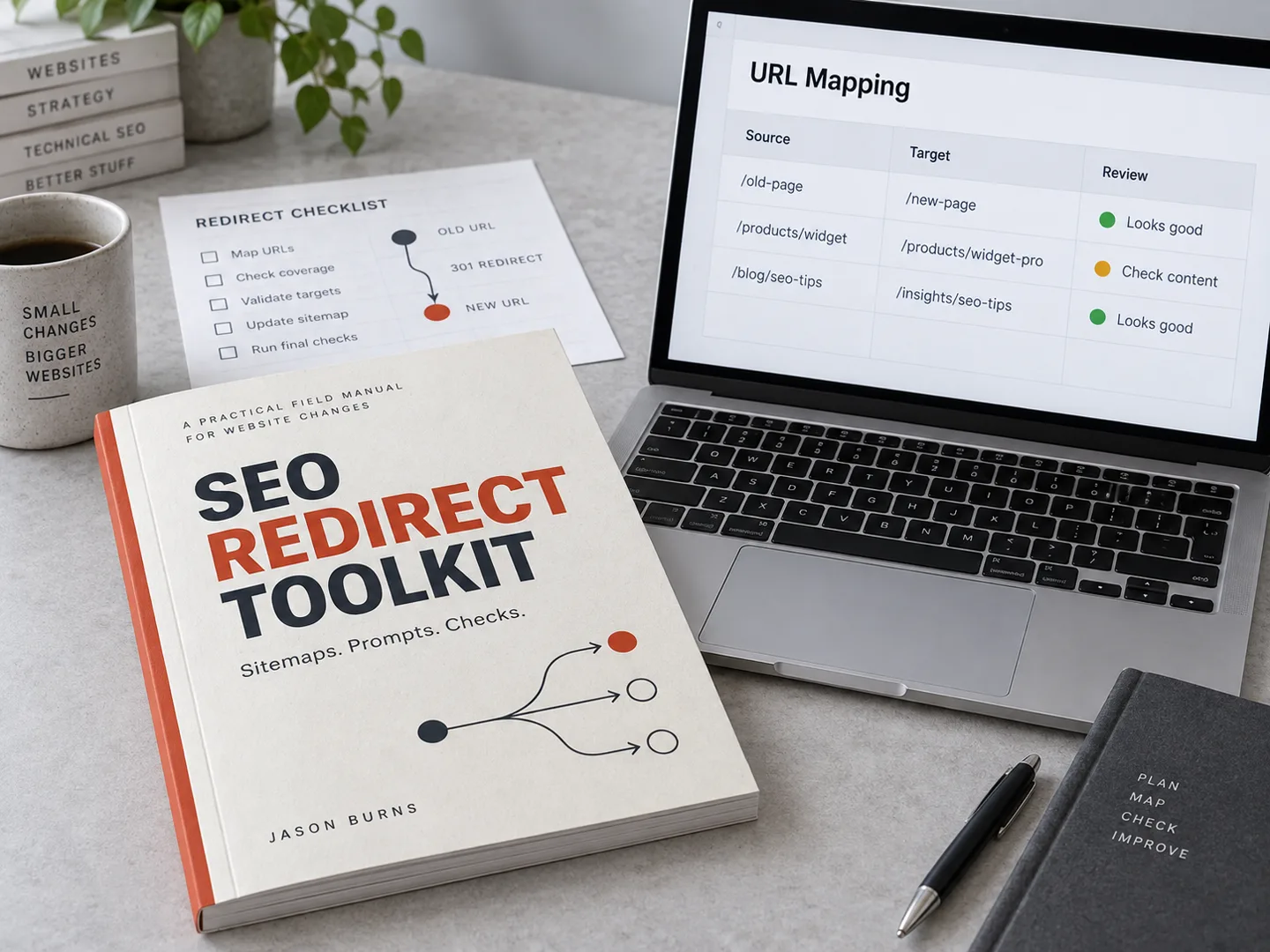
A similar URL can lead to the wrong page.
A boiler repair service and a boiler troubleshooting article share words. They serve different needs. A prompt can still match them if you only give it the URLs.
Give the assistant evidence.
Then check its suggestions. The toolkit records existing redirects, page headings and destination checks so you can review each pair.
| Old page | Proposed destination | Evidence | Next step |
|---|---|---|---|
/boiler-repairs | /services/boiler-repair | 301 → 200 1 existing hop | Already redirects |
/emergency-plumber | /guides/stop-a-leak | Service → article Different purpose | Review the match |
/old-offer | /offers/summer | Target returns 404 | Find a valid target |
Fictional example. Python checks the HTTP evidence. You review page purpose with the prompts.
Start with URLs.
Finish with a reviewed plan.
Run the tool on your computer. Keep the CSV files. Repeat the checks after your developer installs the approved redirects.
- 01
Collect
Read XML sitemaps and sitemap indexes. Add historical URLs from your CMS, Search Console or logs.
sitemap → urls.csv - 02
Check
Record first status, every redirect hop, final URL, title, H1 and canonical for old and new pages.
check → pages.csv - 03
Match
Use the prompts and your page evidence. Keep uncertain matches in a separate review list.
prompts → draft map - 04
Validate
Check both URLs. Flag existing redirects, bad destinations and conflicting targets before installation.
validate → review.csv
The prompts.
The tool.
The worked example.
I have packaged the whole task together. You get the files to run it and a guide that explains the decisions.
Version 1.0.0. English. An AI assistant is optional. Its upload limits and fees are separate.
- .PY
A Python checking tool
Sitemap extraction, page checks and redirect validation. No extra Python packages. Run summaries flag errors and incomplete crawls.
- .MD
Four task-specific prompts
Inventory review, 301 redirect matching, a deployment brief and sitemap cleanup. Each names the inputs and the output you need.
- .CSV
Worked examples
Old and new URL lists, page summaries and a draft map. Includes an explanation of a tempting but unsuitable match.
- .HTML
An offline start guide
Setup commands, the full workflow and links to your files. Plus repeatable local tests and full technical notes.
Try this sample instruction in your next redirect prompt
Review the supplied old and new page inventories.
Only propose destinations that exist in the supplied new inventory.
Match the page's purpose, service or product, and location.
A service page and an advice article are not equivalent just because they share words.
If the source already redirects, report the observed chain before suggesting changes.
Keep uncertain or unmatched URLs in a separate review list. Do not default them to the homepage.
For each candidate, return source_url, target_url, supporting_evidence and review_needed.
Do not say that a redirect is safe to install. A person must check the match and live URLs.
For people doing
the SEO work.
- You can install Python and run a terminal command.
- You have permission to check the websites in your list.
- You want CSV evidence you can inspect and reuse.
- You will review the matches before changing the site.
Need someone to plan and oversee the move? My site migration SEO service covers that separately.
This toolkit reads XML sitemaps and HTTP responses. It does not run JavaScript, crawl every internal link or install redirects. The default limit is 500 URLs per run. You can raise it to 10,000.
No VAT. No subscription. Download the ZIP after Stripe confirms your card payment.
Review your details on Stripe before paying. You return here for your download. Save that private confirmation page for future access.
Licence for your business and its client projects. No redistribution of the toolkit files. Access help and bug support: hello@jasonburns.co.uk.
A few useful answers.
Do I need ChatGPT Plus or an API key?
The Python tool needs neither. You can use the prompts with your preferred assistant. Upload support and file limits vary by account. You can also review the CSVs yourself. Any AI subscription is separate.
Will it crawl my entire website?
It reads URLs from XML sitemaps and checks the lists you give it. It does not follow all internal links or run JavaScript. Gather old URLs from other sources too. Failed sitemap files and crawl limits are flagged in the run summary.
Does it automatically create or install 301 redirects?
No. The prompts help you draft a map. Python checks the URLs and flags technical issues. You confirm the page matches. Your developer installs the approved redirects using your site's platform.
Can I use it for client work?
Yes. The purchasing person or business can use and adapt the toolkit for its own sites and client projects. You can give clients your finished maps and reports. You cannot resell or distribute the toolkit files or prompts.
What happens if a page blocks the checker?
The result records the access problem. A 403, timeout or robots restriction is not called a missing page. Check it in your browser and add the evidence before deciding what to do.
What if I need help with the download?
Email hello@jasonburns.co.uk with your purchase email. I can help with access and reproducible bugs. Website-specific advice and implementation are separate. Your consumer rights remain in place.