Keep
38Earns clicks, answers a real question, and nothing else on the site duplicates it.
Most cleanups keep more than the client expects. Panic deletion is the expensive mistake.
Updated
Google does not penalise a page for being written with AI. It penalises volume without value, whoever produced it. So the job is not deleting everything a model touched. It is deciding, page by page, which ones earned something, which are fighting each other, and which never had a reason to exist.
Almost every article on this subject implies it is. Believing that sends people straight into deleting work that was earning them money.
Read Google's actual wording. The last four words decide the whole job.
Scaled content abuse is when many pages are generated for the primary purpose of manipulating search rankings and not helping users. This abusive practice is typically focused on creating large amounts of unoriginal content that provides little to no value to users, no matter how it's created.
Google Search Central, spam policies · read 20 August 2026
One researched page written with AI help, carrying numbers and a point of view.
Four hundred near-identical pages. Which would also not be fine if a person had written them.
A traffic collapse that happens to follow a batch of AI articles is not proof the articles caused it. Plenty of drops are technical, or link related, or a competitor doing something right. Deleting content to fix a crawl problem wastes months.
I read these dates off Google's Search Status Dashboard, not off an SEO blog. While researching this page I found one outlet reporting an August 2026 core update that does not exist on Google's record. Correlate against a wrong date and you get a wrong diagnosis.
Still rolling out
2 days, 1 hour
11 days, 21 hours
12 days, 4 hours
19 hours, 30 minutes
21 days, 17 hours
Source: Google Search Status Dashboard. Spam updates enforce existing policies. Core updates reassess quality across the whole index. They need different responses.
Earns clicks, answers a real question, and nothing else on the site duplicates it.
Most cleanups keep more than the client expects. Panic deletion is the expensive mistake.
The subject is worth covering and the page ranks for something, but there is no first-hand experience and nothing quotable in it.
Rewriting means adding what was missing. Running it back through a model gives you the same problem in different words.
Several pages chase one query and compete with each other. One of them usually already ranks.
The strongest page absorbs the rest and the others redirect into it.
Earned nothing over a stated window, no subject of its own, exists because a tool produced it.
Backed by that page's own numbers. Never by an opinion about how it reads.
The standard for cutting a page matters more than anything else here. A page is only recommended for deletion when it earned nothing over a stated window and has no subject of its own. That is checkable. You can disagree with any single call, because the numbers behind it are in the report.
Full crawl, then cluster by similarity. Near-duplicate detection catches the templated batches a manual review misses once a site passes a few hundred pages.
Impressions, clicks and average position per URL from Search Console, over a window that predates the drop. This is what makes a deletion defensible rather than aesthetic.
Unoriginal content, no first-hand experience, keyword-shaped with nothing a reader could not get elsewhere, thin variants of a sibling. Google's criteria, not a rewrite of them.
Bulk publishing produces cannibalisation almost every time. Several pages chase one query and none of them wins it. Merging usually recovers more than cutting does.
Different problem, same visit. I audited 56 UK accountancy firms in May 2026 and more than a quarter blocked AI crawlers at the hosting layer while robots.txt looked clean.
One row per URL: the outcome, the reason, the numbers behind it. Ordered so the highest-impact work sits at the top.
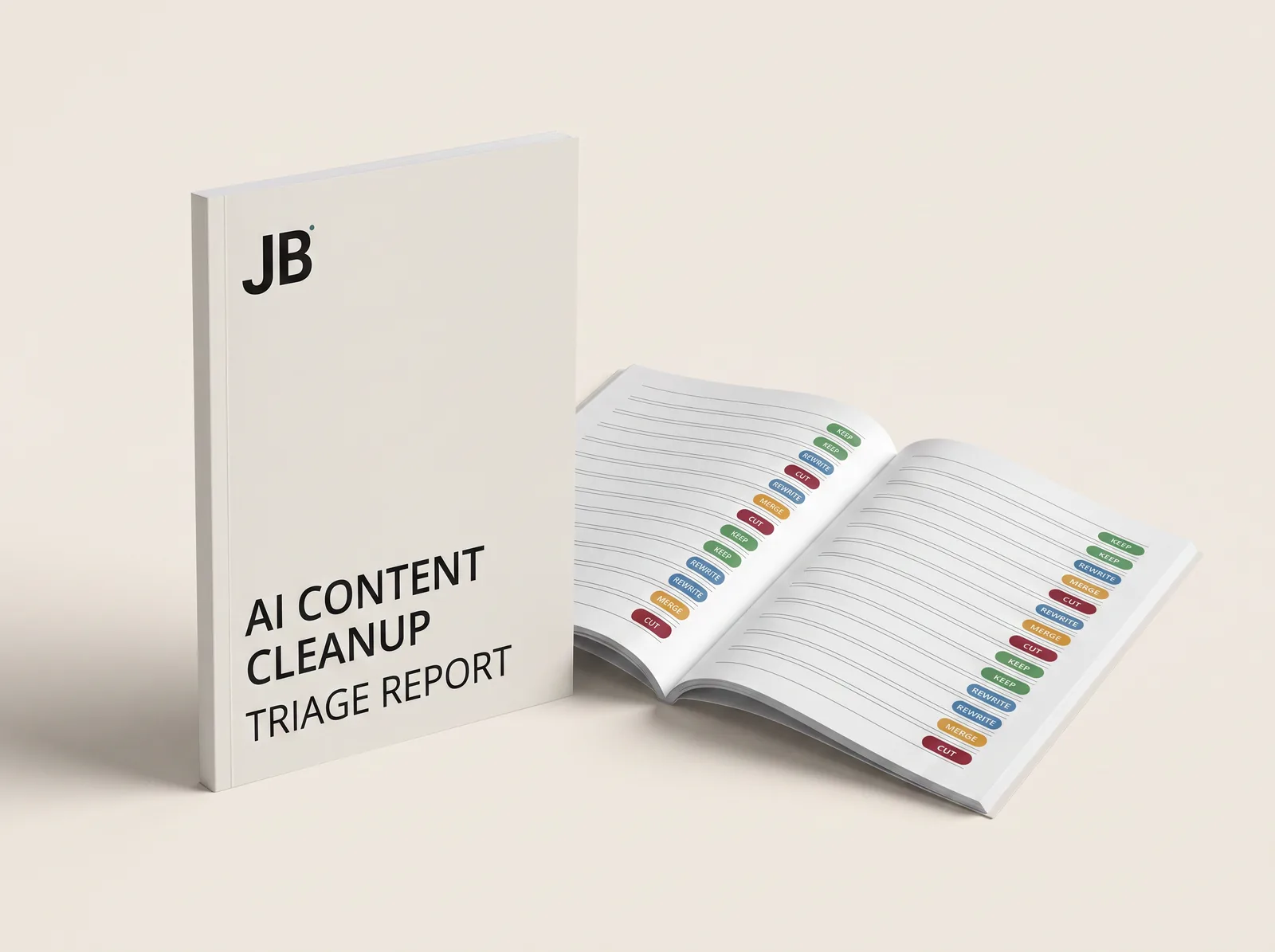
Implementation is quoted separately once the size of the job is known, because a site with 80 pages to review and one with 4,000 are different jobs.
Buy the triage reportBefore you spend anything: send the domain and the date your traffic dropped, and I will tell you whether it lines up with a Google update. That part costs you an email.
is how far click-through fell on queries that never showed an AI Overview at all, so blaming the whole decline on AI Overviews overstates their effect.
How it was measured: Same dataset, comparing September 2025 against September 2024. Queries with an AI Overview fell 61% from June 2024 to September 2025, a slightly longer window. Both fell, so the two figures are not a clean measure of the feature on its own.
of UK Google searches end without a click on anything, the highest rate of the six countries measured and above the United States at 68.0%.
How it was measured: Similarweb mobile and desktop clickstream panel, January to April 2026. Zero-click means no click to anywhere, including to Google's own properties and to paid results. Germany was lowest at 62.1%.
more organic clicks went to a brand cited inside an AI Overview than to one that was not, in Seer's 2025 study (data to September 2025). Treat it as dated: Seer's April 2026 update says cited brands saw lower click-through as impressions more than doubled while clicks stayed flat.
How it was measured: 3,119 search terms across 42 client organisations, 25.1M organic and 1.1M paid impressions, June 2024 to September 2025, so the data is now more than 12 months old. Informational and educational queries only, which are the ones most exposed to AI Overviews, so this is not a whole-market figure. In absolute terms it is 0.70% against 0.52%. Paid click-through was 91% higher when cited.
Click-through has fallen on queries that never showed an AI Overview at all, so not all of your decline is necessarily the content or the update. And in the UK more searches end without a click than anywhere else measured. Cleaning up the content is the right work. Expecting 2023 traffic back is not.
No. The policy targets volume without value and says so: "no matter how it's created". One good page written with AI help is not a problem. Four hundred near-identical ones are, and they would be if a person had written them.
No, and mass deletion often makes it worse. Some of those pages earn clicks. Cutting is only recommended where the page earned nothing over a stated window and has no subject of its own.
Usually not. If the problem was that the pages said nothing a reader could not get elsewhere, regenerating them gives you the same problem in different words. What was missing was first-hand experience, original numbers and a reason for the page to exist. A model cannot supply any of those.
Longer than the cleanup takes. Google has to recrawl and reassess, and reassessment often waits for the next update rather than happening continuously. The work finishes in weeks. The recovery is measured in months. Anyone giving you a date is guessing.
Sometimes. But if they published the content, get an independent read before you accept their assessment of it. That is not a dig at them. Nobody audits their own work well.
Then I tell you that, and the report has still done its job. Finding out your problem is technical before you delete four hundred pages is worth £395 on its own.
I will tell you whether it lines up with a Google update before you spend anything.
Get in touch