
Key takeaways
- Hermes Agent is scaffolding for AI workflows, not an SEO tool. The thing it gives you is repeatable agents that learn, schedule themselves and reach you across Telegram, Slack, email and CLI.
- The killer SEO use cases are scheduled monitoring, multi-tool orchestration (GSC + Ahrefs + GA4 in one conversation) and skills that compound - not content generation.
- Run on a VPS that costs under £10 a month, or serverless. The real cost is the model API, not the framework. Budget £30-150 a month for a working SEO setup.
- Where it burns teams without an expert: HCU-style content fluff, hallucinated schema, agentic crawling that triggers WAFs, and skill prompts that drift over weeks until the agent silently does the wrong thing.
Updated What changed on
Fact-checked The Hermes Agent GitHub repo, docs and v0.19.0 and v0.22.0 release notes, the Anthropic and OpenAI model pages, Hetzner's price notice, Nous Portal plans, and the SerpApi, DataForSEO, Ahrefs and Search Console API pages were re-checked at the source on 14 October 2026, as were OpenAI's ChatGPT agent help page, the ChatGPT pricing page and Google's How-to deprecation notice. Cost bands and client stories are my own and were not re-measured.
- Swapped in the current install commands, including native Windows, and noted the new desktop apps.
- Fixed the approval advice: the setting is approvals.mode, and since July 2026 a second model approves flagged commands unless you set it to manual.
- Corrected where API keys live: a chmod 600 .env file by default, or Bitwarden and 1Password. Honcho is now an optional plugin, not built in.
- Added a short table of the SEO APIs an agent calls, with October 2026 prices for SerpApi and DataForSEO, and the Ahrefs hosted MCP server.
- Updated model names, the Hetzner price (CX22 has gone, CX23 is the entry plan) and the OpenAI entry in the alternatives table.
- Replaced the unsourced star and popularity claims with the October 2026 star count and Nous Research's own attributed claim.
- Corrected the OpenAI row in the alternatives table: OpenAI has retired ChatGPT agent, which absorbed Operator, and ChatGPT Work now handles multi-step tasks.
- Noted that Google retired How-to rich results in September 2023, so HowTo markup no longer shows a visible result.
- Fixed the ChatGPT comparison answer: ChatGPT Plus does offer scheduled tasks.
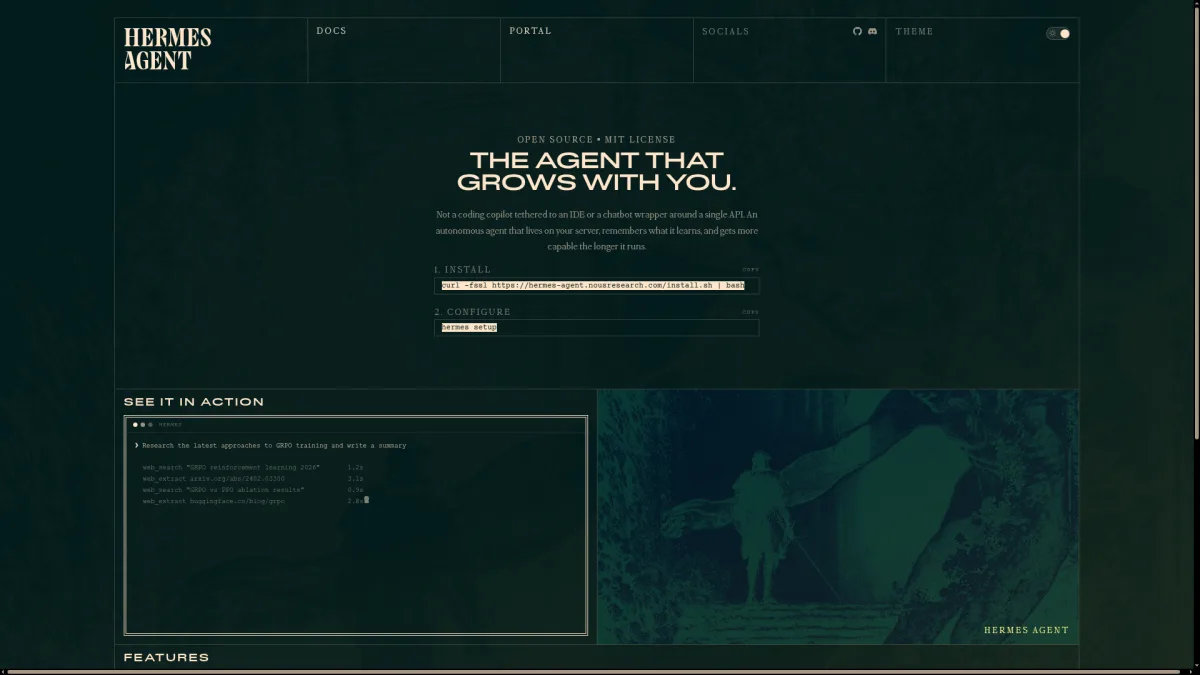
Hermes Agent is the open-source AI agent framework from Nous Research. Nous released it under the MIT licence in February 2026, and on 14 October 2026 its GitHub repo had 253,627 stars. The premise: an agent that lives across your tools, builds skills from experience, schedules itself, talks to you on Telegram or Slack, and remembers what you have asked it before.
An SEO agent is a language model with access to your SEO tools' APIs and a schedule to run on. It pulls the data, decides what matters and tells you, without someone clicking through each tool by hand. Hermes is one way to build one.
Nous Research says that "by many metrics" Hermes is "the most widely used open source AI agent in the world". That is their own claim, not an independent count. Either way, SEO teams are starting to deploy it for genuine work. This guide covers what it does, which SEO APIs it calls, what it costs, where it earns its keep on an SEO programme, where it will quietly hurt your rankings if you let it run unsupervised, and what a consultant adds on top.

What Hermes Agent actually is#
Strip away the marketing language and Hermes is three things bundled together:
- A terminal UI with persistent memory. Type
hermesand you get a chat with a learning loop. The agent stores conversations in a local SQLite database with FTS5 full-text search, so it can look back through old sessions. User-modelling memory such as Honcho, which builds a deepening picture of who you are over weeks, is now an optional plugin you install from the plugin catalog rather than part of the core. - A gateway that connects to messaging platforms. Same agent, reachable from Telegram, Discord, Slack, WhatsApp, Signal, email and a web dashboard. One conversation can drift between platforms without losing context.
- A skill and tool system. Hermes can spawn isolated subagents, run shell commands across seven execution backends (local, Docker, SSH, Singularity, Modal, Daytona, Vercel Sandbox), and write its own skills after solving complex tasks.
The model is not built in. You point Hermes at a provider - Nous Portal (which the docs call the recommended way to run it), OpenRouter with hundreds of models, NVIDIA NIM, OpenAI, Anthropic, Google Gemini, AWS Bedrock, a model running on your own machine or your own endpoint - and switch with hermes model whenever you want. The docs listed about 45 provider routes in October 2026.
It has moved quickly since this guide first went up in May. The current release in October 2026 is v0.22.0. Since May it has added desktop apps for Windows and macOS, a plugin catalog of about 600 reviewed plugins, connectors that let it act in hosted apps such as Gmail, Linear and Notion, and one-click local models that run through llama.cpp. In October 2026 Nous Research also announced a $90 million raise, partly to build a business version called Hermes for Businesses.
The combination is what makes it different from chatting with ChatGPT or running a single-shot Claude script. Hermes is a persistent operator that keeps working when you close the laptop.
Why SEO teams are paying attention#
Most SEO work is repeated, semi-structured, multi-tool, and ripe for an agent that does not need babysitting. A short list of jobs that map cleanly to Hermes:
- Pull yesterday's Search Console performance, flag the queries with double-digit position drops, and ping the on-call SEO on Slack
- Crawl the staging environment overnight, diff the output against last week, and report any new noindex tags or broken internal links
- Watch a competitor's sitemap for new URLs, summarise the content and notify the content team within the hour
- Generate technical SEO audit briefs that pull live Ahrefs data, GSC performance and GA4 conversion signals into a single report
- Schedule a Monday morning summary that combines all of the above into a 200-word brief sent over WhatsApp
You can hire an agency to do those things. You can also write Python cron jobs that do them. Hermes sits between those two options: cheaper than the agency, more natural-language and easier to modify than the cron jobs.
That is the appeal. The question for SEO teams is whether the appeal survives contact with the messy reality of search work.
The setup most teams get wrong#
The fastest installs I see in client work look like this:
# Linux, macOS or WSL2 - one-liner from the official docs (October 2026)
curl -fsSL https://hermes-agent.nousresearch.com/install.sh | bash
source ~/.bashrc
hermes

# Native Windows, in PowerShell
iex (irm https://hermes-agent.nousresearch.com/install.ps1)
The older GitHub install URL this guide used in May still served the same script when I re-checked it in October 2026, but the command above is the one the docs now give. There are also signed desktop apps for Windows (Windows 11 22H2 or later) and Apple Silicon Macs.
Two minutes later you are in a working agent. The mistake is what comes next. People wire Hermes directly into their live production environment - the real CMS, the real schema deployment, the real internal link graph - because they trust the demo they just saw.
The agent then does something useful nine times out of ten and something catastrophic the tenth time. A skill that was tested on three URLs gets applied to three thousand. A schema generator hallucinates a Person property and pushes it live. A scheduled cleanup script deletes draft posts that the editor was about to publish.
The right setup splits the work into three tiers:
| Tier | What runs there | Example |
|---|---|---|
| Read-only sandbox | Anything that touches a live system | GSC pulls, Ahrefs queries, public-page crawls |
| Staged writes | Anything that modifies content or config, with a human approval step | Schema markup proposals, draft content, redirect maps |
| Direct writes | Only the narrowest, most-tested skills, after weeks of stable behaviour | Sitemap regeneration, robots.txt updates against a tested allowlist |
Hermes makes this easy if you remember to set it up. Approval is controlled by approvals.mode in ~/.hermes/config.yaml. Since v0.19.0 (20 July 2026) the default is smart: a second model approves commands it judges low-risk, blocks the clearly dangerous ones and only asks you about the rest. If you want a human to confirm every flagged command, set it to manual. Set skills.write_approval: true as well, so any skill the agent writes or edits waits for your review. Run write-capable skills inside a Docker or Daytona sandbox so a bad agent decision touches a container instead of your prod database.
Without those guardrails, the first time a model update changes how the agent reasons about a prompt - which happens every couple of months as OpenAI, Anthropic and Nous ship new versions - you will discover a regression in production rather than in staging.
SEO workflows where Hermes genuinely earns its keep#
These are the patterns I saw work in real client engagements in the three months before this guide first went up in May 2026.
Scheduled SERP and ranking monitoring#
The cron scheduler is built in. A natural-language instruction like "Every weekday at 9am, pull the top 50 ranking queries from Search Console for the last 7 days. Compare to the previous 7 days. If any query has dropped more than 10 positions, send a Slack alert to #seo-ops with the query, the URL, the old position and the new position. Skip queries with fewer than 10 impressions." compiles to a recurring job that runs unattended.
That replaces a manual check that no in-house SEO actually does reliably. The cost is one paid API call to the LLM plus a Search Console API call, which has to stay inside Google's per-site and per-user quotas.
Multi-tool orchestration in a single conversation#
This is the standout. In one Hermes session you can ask:
Pull the slow-loading pages from CrUX, cross-reference them with the pages converting well in GA4, look up which of those pages also appear in the top 20 for a high-volume query in Ahrefs, and rank-order the result by conversion-weighted opportunity.
Hermes calls GSC, GA4, Ahrefs and CrUX through MCP servers or REST APIs, then composes the answer. You skip the spreadsheet shuffle between four browser tabs.
The work that an SEO consultant does to prepare this workflow is non-trivial. The credentials wiring, the rate-limit handling, the schema mapping between tools and the decision rules about what counts as opportunity all need expert judgement. Hermes is the runtime. The setup is craft.
Skills that compound over time#
The skill system is the killer feature. After Hermes completes a complex task it can write itself a reusable skill - effectively a stored procedure with prompts, tool calls and decision logic - that becomes available as a slash command next time.
A skill called /serp-audit might:
- Take a URL and a target query
- Pull the live SERP via SerpApi
- Extract the top 10 results
- Compare your page's headings, entities and answer blocks against the winners
- Output a recommendations list scored by impact
Build that skill once with an expert in the room. Run it 200 times over the next year on different URLs. The marginal cost approaches zero.
If you are looking for ready-made Hermes SEO skills, start with the community Skills Hub (compatible with the agentskills.io open standard). It listed more than 100,000 skills across several registries in October 2026. I did not find an official SEO skill from Nous, so search the hub for SEO and expect to adapt whatever you find to your stack. For SERP data there is a community SerpApi plugin, added to the plugin catalog on 2 October 2026 and installed with hermes plugins install serpapi. The obvious catalog pages for DataForSEO, Ahrefs, Semrush and Search Console plugins did not exist when I checked in October 2026.
The vibe is the same as installing a plugin from a marketplace - you treat the listed code as a starting point, not a finished tool. The catalog itself says its review "is not a security audit", so read the code of anything you hand credentials to.
Cross-platform reporting#
Most SEO reports get ignored. They land in an inbox at 7am on Monday morning, the recipient skims the summary, and the underlying detail never gets opened.
Hermes lets you deliver the same report through whatever channel a stakeholder actually checks. The CMO who reads WhatsApp gets a 200-word brief. The dev lead who lives in Slack gets a ticket-shaped summary with proposed fixes. The CEO who skim-reads email gets a one-paragraph headline. Same source data, different framing per channel, generated by the same agent in one cron run.
SEO workflows where Hermes is a footgun#
Three patterns I see attempted that go wrong without expert oversight.
Content generation at scale#
The temptation is obvious. Hermes plus a frontier model can draft a 1,500-word blog post in 90 seconds. Two clicks to publish. Done.
This is the exact pattern Google's Helpful Content system is trained to detect. Not because AI wrote the post - HCU does not care who wrote it - but because the prompt that fits in a single Hermes turn produces prose that lacks specific examples, real numbers, named sources, contradictions, opinions and the small dose of personality that earns trust.
I have seen sites publish 200 AI-drafted posts and watch their organic traffic halve in the following core update. The cost of the prompts was £8. The cost of the recovery was nine months of careful republishing.
Hermes does not solve the content quality problem. It accelerates whichever direction you point it. With a consultant in the loop, the workflow becomes: Hermes drafts the structure, the consultant writes the parts that need experience, the editor approves, the article ships. Volume drops to two posts a week. Traffic compounds.
Schema markup generation#
Schema is structured trust. Get it wrong and you either get nothing (the engines ignore broken markup) or you get penalised for misrepresentation (claiming a Review rating you do not have).
LLMs hallucinate schema fields. They invent Organization properties that do not exist. They use deprecated values for MedicalCondition. They populate Review.itemReviewed with the wrong entity type. They mark up content as HowTo when it is Article. Google retired How-to rich results in September 2023, so HowTo markup no longer produces a visible result in Search anyway.
Hermes will generate confident-looking JSON-LD that validates in the schema generator but fails in real-world surfaces. The fix is not "use a better model" - the fix is having someone in the loop who knows that Service requires provider and areaServed to be properly nested, knows when LocalBusiness is appropriate and when it is overreach, knows that aggregateRating requires actual reviews to back it up, and reviews everything the agent proposes before it ships.
Agentic crawling on sites you do not own#
Hermes can crawl any URL you point it at. Several skills in the community hub do exactly this for competitor analysis.
The problem: a SiteGround or Cloudflare WAF will block a crawler that requests 50 URLs in 30 seconds from a residential IP. Your VPS gets banned. Worse, if the WAF logs include your domain in the referrer header (some do), you have just told a competitor that you are watching them.
A consultant who has run crawls professionally knows to rate-limit, rotate UA strings, respect robots.txt, never crawl behind authentication that does not belong to the agent, and avoid crawling competitor login or checkout pages even when robots permits it. Hermes will do whatever you ask. The judgement is yours.
The SEO APIs an agent like Hermes calls#
Hermes does not come with SEO data. It calls the APIs of the tools you already use, through an MCP server, a plugin or a plain REST call. Here are four common ones, with what each cost when I re-checked them at the source in October 2026.
| API | What it gives the agent | Cost (October 2026) | How Hermes connects |
|---|---|---|---|
| Google Search Console API | Your own site's search performance data | Limited by quotas, such as 1,200 queries a minute per site and per user | REST |
| SerpApi | Live Google search results | Free for 250 searches a month, then from $25 a month for 1,000 | Community plugin: hermes plugins install serpapi |
| DataForSEO | SERP, keyword, backlink and LLM mention data | Pay as you go: $50 minimum top-up that does not expire, plus a $1 trial credit | REST, or MCP |
| Ahrefs | Site Explorer, Keywords Explorer and SERP Overview data | API on eligible paid plans; I did not re-check Ahrefs prices | Official hosted MCP server from the Lite plan up, which uses API units |
GA4 and CrUX also come up a lot in client builds. I did not re-check their limits for this update.
Real costs, broken down#
| Component | Monthly cost | Notes |
|---|---|---|
| Hermes framework | £0 | MIT licensed, no subscription |
| VPS or serverless | Under £10 - £40 | Hetzner's entry CX23 plan is €5.49 a month before VAT and IPv4 (June 2026 price; CX22 is no longer listed), Daytona/Modal serverless ~£10-40 depending on activity |
| Model API (low use) | £15 - £30 | Llama 3.3 70B or Claude Haiku for routine cron jobs via OpenRouter |
| Model API (active use) | £60 - £140 | Claude Sonnet 5.5 or one of OpenAI's GPT-6 models for analysis and skill development |
| Storage / observability | £0 - £5 | Local SQLite is free; add Sentry or Honeycomb if you want traces |
| SEO tool subscriptions | Existing | Ahrefs, Semrush, Screaming Frog, GSC, GA4 are unchanged |
| TOTAL | £30 - £150 | Realistic working SEO setup (my estimate from May 2026; model prices were not re-checked for this update) |
The biggest cost driver is which model you use. Default to the smallest model that gets the job done. Use a frontier model only for the work that needs reasoning.
The setup work is the hidden cost. Wiring Hermes into a working SEO stack with credentials, MCP servers, scheduled jobs, skill prompts, output formatting and approval flows is a 2-5 day piece of expert work. Once it is built it largely runs itself, but the build is not optional.
Where an SEO consultant earns the cost#
Reading the above, you can probably see where the line is. Hermes is the runtime. Someone has to:
- Decide which questions are worth automating and which are not. Most clients want to automate the work that is hardest to automate and easiest to do manually.
- Build the prompts and skills with current SEO judgement baked in. The same task prompt that worked in 2024 misfires in 2026 because algorithm sensitivity has shifted.
- Set guardrails that survive a model upgrade. An agent that worked perfectly on one model version will sometimes do dangerous things on the next without warning. Anthropic retires Claude Sonnet 4.5 on 30 November 2026, so any agent still pinned to it has to move to a newer model such as Sonnet 5.5 anyway. Tested behaviours need re-testing.
- Review what Hermes is about to publish, push or send. Particularly for schema, redirects, content and outreach. A wrong sitemap can deindex a site overnight.
- Hold the strategy. Hermes will happily optimise a metric. The hard part is knowing which metric to optimise this quarter and why.
If you already have those skills in-house, Hermes accelerates you. If you do not, Hermes builds a system that fails confidently and quietly.
That second failure mode is the one I see most often. The site does not crash. Rankings just slowly drift down because the agent kept doing the wrong thing for three months and nobody knew because the dashboard looked green.
Setup walkthrough (abbreviated)#
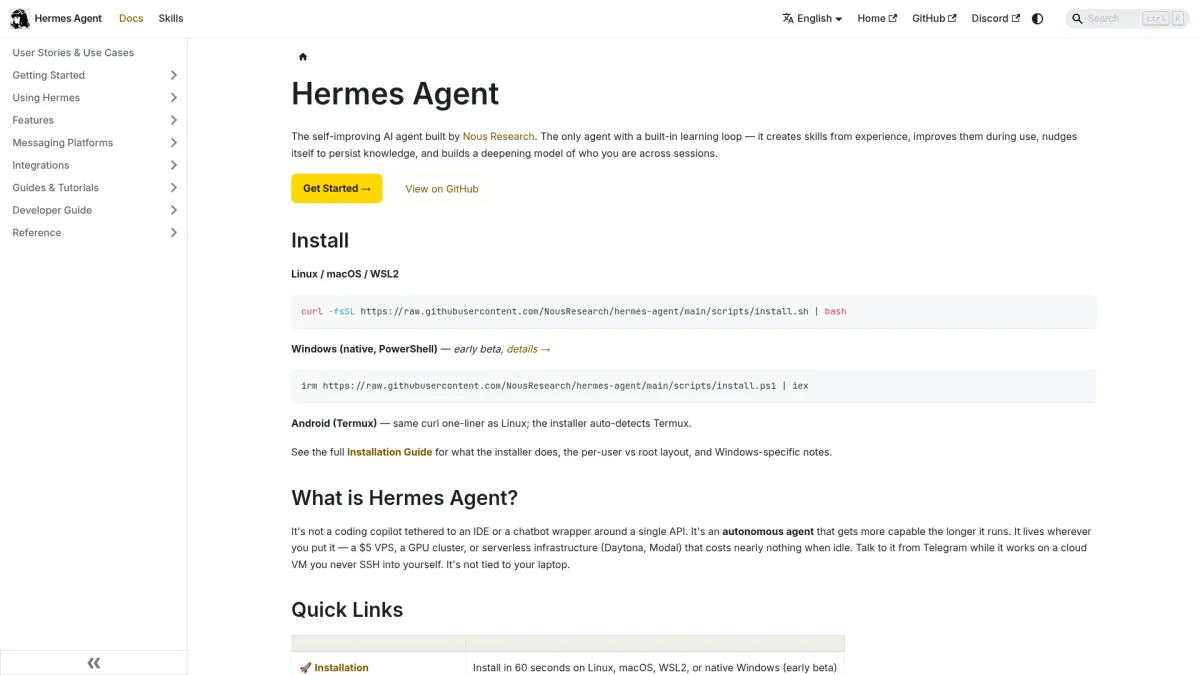
The full install is well-documented at hermes-agent.nousresearch.com/docs. The condensed version for an SEO context:
- Install on a server, not your laptop. Hermes is built to live on a remote machine and have you talk to it from anywhere. A small VPS costing under £10 a month is enough.
- Configure the model.
hermes modeland pick a provider. OpenRouter is the most flexible because it lets you swap models without changing keys. - Wire SEO credentials. GSC OAuth, GA4 service account, Ahrefs API token, SerpApi key. By default Hermes keeps API keys in
~/.hermes/.env, so lock that file down withchmod 600. Better still, since v0.19.0 (July 2026) it can pull keys from Bitwarden or 1Password, so they never sit in a plain-text file. - Set up MCP servers for the tools you use. Many SEO tools already have community MCP servers, and Ahrefs now runs an official hosted one. If not, a short Python wrapper around their REST API does the job.
- Turn on manual approval. Set
approvals.mode: manualin~/.hermes/config.yamlso the agent has to ask you before running anything flagged as dangerous. The defaultsmartmode lets a second model decide instead. - Start with read-only skills. Add five or six skills that only read data and report. Run them for a fortnight. Watch for drift.
- Add staged writes once read-only is boring. Schema proposals, content drafts, redirect maps - all with a human approval step.
- Schedule the recurring jobs. Daily SERP check, weekly competitor diff, monthly schema audit.
- Connect the gateway to whichever messaging platforms you actually use. Telegram is the smoothest, Slack is the most professional.
- Set up logging. Either via Hermes' built-in session FTS5 search, or pipe to a real observability stack if you want traces.
Plan on a fortnight of setup and tweaking before you trust the agent with anything important. The investment is real but the running cost after is trivial.
Alternatives worth considering#
Hermes is not the only agent framework. The 2026 shortlist for SEO use:
| Tool | Strength | Weakness for SEO |
|---|---|---|
| Hermes Agent | Skills system, multi-platform gateway, model flexibility, persistent memory | Setup complexity, no SEO-specific tooling out of the box |
| OpenAI Agents SDK | Tight integration with GPT models. OpenAI's browser-using agent, once called Operator, was folded into ChatGPT agent. OpenAI has since retired ChatGPT agent, and ChatGPT Work now handles multi-step tasks | Locked to OpenAI, less flexible scheduling, weaker memory model |
| Anthropic Claude Agent SDK | Best reasoning model in 2026, strong for analysis tasks | Smaller ecosystem of community skills, no native multi-platform gateway |
| n8n / Make.com | Visual workflow builder, lots of pre-built SEO nodes | Not really an agent - more workflow automation; weaker for natural-language reasoning |
| CrewAI / LangGraph | Multi-agent orchestration patterns | Heavier engineering investment; better for product builds than internal tooling |
The right choice depends on what you are optimising for. Hermes is the best general-purpose answer if you want a persistent agent that lives across tools and platforms. n8n is the right answer if you want a flowchart of predictable workflows. The Claude Agent SDK is the right answer if you want pure reasoning quality and can write your own scheduling.
When to use Hermes Agent#
- You have a working SEO programme with real tools, real data and at least one senior person who understands the work.
- You want to automate the repetitive parts of that programme without giving up control.
- You can spend two weeks on initial setup and review the output weekly thereafter.
- You can budget £30 to £150 a month for model API and infrastructure.
- You will have human approval on anything that touches the live site.
When not to use Hermes Agent#
- You think it will write SEO content that ranks without editorial. It will not.
- You want to set it up once and never look at it. Agents drift without re-tuning.
- You do not have a senior SEO who can sanity-check what it produces. Without that layer, an agent on a live site is faster damage at lower cost.
- Your stack is small enough that the manual work takes 30 minutes a week. The setup will not pay back.
The pattern that works#
Hermes Agent is a powerful runtime in the hands of someone who already does SEO well. It is a way to give that person more reach over the repeated, error-prone, multi-tool jobs that fill an SEO week. Used that way, it earns its keep within a month.
Without that person in the loop, it is a very efficient way to systemically degrade a site's quality signals while showing you green dashboards. The framework will not protect you from yourself.
If you want to set this up with the SEO judgement baked in from the start, that is what I do for clients. Pricing is on the pricing page and the contact form is the way in.
Frequently asked
Is Hermes Agent free to use?
Can Hermes Agent replace an SEO tool like Ahrefs or Semrush?
Will Google penalise content created with Hermes Agent?
How does Hermes Agent compare to running ChatGPT or Claude directly?
What is the cheapest way to run Hermes Agent for SEO?
Does Hermes Agent work well with Laravel or PHP stacks?