
Key takeaways
- Since mid-2026 Google has changed how its results reach rank trackers. Vendors including DataForSEO, Semrush, SISTRIX and AccuRanker have published notices about unresolved links and swapped result pages.
- Nozzle found page 1 or 2 swapped on 26.9% of the results pages it judged since 13 September 2026, against 0.28% before. Its worst day so far was 31 October, at 64.0%. That is Nozzle's sample, not every search.
- Google's own numbers moved too. Google logged impressions wrongly from 13 May 2025 to 27 April 2026, and FAQ results stopped showing on 7 May 2026.
- If your rankings look fine but traffic is falling, AI Overviews are one documented cause. A rank number alone cannot tell you that.
- A trustworthy report states device, location, time, depth and number of runs, and labels any result it could not check as unresolved, not as lost.
Updated What changed on
Fact-checked On 4 November 2026 I re-checked Nozzle's study. The other vendor figures are as checked on 3 November 2026.
- Nozzle figures updated to its 1 November 2026 data: 26.9% average since 13 September, and a new worst day of 64.0% on 31 October.
- Added a short answer, a diagram of how a rank check goes wrong, a chart of Nozzle's figures, a vendor table, a timeline and the results of my four checks.
Your SEO ranking report may be wrong right now, and nobody in the chain has to be careless for that to happen. Google changed how its results reach rank trackers in 2026: some trackers now receive redirect links instead of real addresses, and some receive a results page that has been swapped for the wrong one. Below: what changed, how it skews your monthly numbers, and a checklist for a report you can trust.
Short answer. A ranking report can be wrong because the data behind it was affected: some results arrive as redirect links the tracker cannot identify, some arrive as a swapped results page, and Search Console has had its own dated breaks. A trustworthy report says how each number was checked. It labels anything it could not check as unresolved, not as lost.
What changed at Google in 2026#
Two things changed this year, on top of a change from 2025.
- Rank trackerAsks GoogleRequests a results page for one phrase
- GoogleMay swap the pageA page that looks complete but holds a different set of sites
- LinksArrive as /gotoRedirects, not real addresses. DataForSEO's fastest modes resolve about 50%
- Your reportGap or wrong positionA missing field, or the wrong set of sites
Redirect links instead of real addresses#
Vendors describe Google routing clicks on results through an internal address that starts google.com/goto. A rank tracker reads those addresses to work out which site sits at which position. If the address is a redirect, the tracker cannot see the site behind it without an extra step.
The vendors do not agree on when this began. SISTRIX says that since June 2026 Google has been routing clicks through an internal /goto URL (SISTRIX, 7 October 2026). DataForSEO says that at the end of August Google introduced google.com/goto passthrough URLs (DataForSEO, 2 November 2026).
I cannot settle that from outside, so I name both.
What DataForSEO said on 2 November 2026 is more useful. Google throttles how many of these links can be resolved for each results page.
DataForSEO's Standard Priority queue resolves all of them but runs slower. Its High Priority and Live modes resolve about 50%, because of the time limit and Google's throttling.
DataForSEO adds that changing IP address does not help, and nor does waiting an hour.
So a tracker can return a successful response and still hold results it could not identify. That is a missing field. It is not a lost ranking.
Swapped, or "poisoned", result pages#
The second problem is harder to spot. Sometimes Google returns a page of results that looks complete but holds a different set of sites from the usual one. The vendors call these poisoned SERPs.
SERP means search engine results page. DataForSEO describes its test as fewer than half of the sites that normally appear for that keyword appearing anywhere on the page.
The figures I could confirm, each with its source and date:
| Vendor | Date | What it reported |
|---|---|---|
| Nozzle | Updated 1 November 2026, data to 1 November | 26.9% of results pages it judged on both pages had page 1 or 2 swapped since 13 September, against 0.28% before. It reached 43.5% on 30 September, fell to 5.7% and 3.8% on 14 and 15 October, then rose to 35.7% on 21 October and 64.0% on 31 October, its worst day so far. Page one alone was 14.3% against 0.17%. These are Nozzle's sampled rates, not a share of all searches. |
| DataForSEO | 23 October 2026 | Swapped pages were about 20 to 30% of its scraped results since 26 September. After two retries with history checks, 2 to 3% were still swapped. |
| AccuRanker | Data to 25 October 2026 | On 24 October, 40% of its first desktop fetches were swapped. After its checks, 3.2% of the sampled desktop keywords still had a swapped page 1. Those two numbers use different denominators, fetches and keywords, so do not read them as a before and after of one thing. |
| Semrush | 27 October 2026 | It excludes clearly invalid results, has changed its data sources, and collects flagged results again. It also says Google has not commented publicly. |
| SISTRIX | 7 October 2026 | If a new result fails its check, it collects the keyword again until a verified result is available. Some keywords update less often, and on-demand updates have been switched off since September 2026. |
Nozzle's figures are the ones I chart, because they share one measure over time. They show the problem easing in mid-October and then getting worse.
None of this makes those vendors unreliable. They published the problem and what they are doing about it.
It does mean a report is only as good as the checking behind each number. Ask whether your report shows that checking.
Background: the 2025 depth cuts#
This part is more than a year old, so read it as background. In September 2025 a change at Google led trackers to shorten how deep they look.
Wincher said from 18 September 2025 it would return rankings up to position 30 only. AccuRanker said on 25 September 2025 it would track the top 30 daily and the top 100 every second week, carrying forward older values for positions 31 to 100. Moz said that from 20 October 2025 its Campaign rank tracking and Rank Checker would report on the first two pages only.
Those policies may have changed since. If your report shows a keyword "dropping out of the top 100", ask which of those rules sit behind it.
Why Search Console numbers moved too#
You might think Search Console, Google's own free tool, is the safe comparison. It moved as well, and Google lists the breaks on its data anomalies page (checked 3 November 2026):
- 13 May 2025 to 27 April 2026: a logging error meant Google did not accurately report impressions. Google says impressions, click-through rate and average position were affected, and clicks were not. You may see a drop in impressions as a result.
- 28 February and 1 March 2026: these two days are missing from the bulk data exports for some properties, and Google says the data will not be recovered.
- 7 May 2026: FAQ rich results stopped appearing in Google Search, so reported FAQ impressions fell.
Google also launched generative AI performance reports on 3 June 2026 and says they reached all websites worldwide by 31 August 2026. They list impressions for AI Overviews and AI Mode by page, country, device and date. The documentation names no clicks, queries, click-through rate or position for that report.
Google's anomalies page says that report under-counted impressions from 13 to 17 August 2026, and the data was restored on 21 August.
So when Search Console and a rank tracker disagree, neither is automatically the right one. Mark the break dates on any chart before you compare.
2025 to 2026 at a glance#
The main dated breaks above, in one place. The ones marked in red matter most for a ranking report.
- 13 May 2025: Google starts logging Search Console impressions wrongly. Clicks are not affected.
- Depth cuts. Wincher limits rankings to position 30 from 18 September. AccuRanker follows on 25 September, tracking the top 30 daily and the top 100 every second week.
- 28 February and 1 March: two days missing from some Search Console bulk exports. Google says the data will not be recovered.
- The impressions logging error that began on 13 May 2025 ends.
- FAQ rich results stop appearing in Google Search, so reported FAQ impressions fall.
- Google starts routing result clicks through
google.com/goto. SISTRIX dates this to June. DataForSEO dates it to the end of August. - Google launches generative AI performance reports in Search Console.
- Nozzle's swapped-page rate jumps from 0.28% before this date to an average of 26.9% since.
- Nozzle's September peak: 43.5% of the results pages it judged had page 1 or 2 swapped.
- Nozzle's worst day so far: 64.0% of the results pages it judged had page 1 or 2 swapped.
- DataForSEO says its High Priority and Live modes resolve about 50% of
google.com/gotolinks.
Rankings fine, traffic down#
Some businesses see a different problem: the ranking report says position 3, and the visits are falling anyway.
AI Overviews are one documented cause. Agarwal and Sen, in a paper posted on SSRN on 3 April 2026 (1,065 desktop Chrome users, data collected 7 January to 10 February 2026), found that when an AI Overview appears, outbound organic clicks fall 39.8% and zero-click searches rise 34.5%.
Brainlabs reported on 14 September 2026 that across 54 clients, organic sessions fell 10.5% from January to August 2025 to September 2025 to April 2026. Of the 54 clients, 46 saw a decline, and referrals from AI tools made up only around 5% of the lost sessions.
Agencies are hearing about it. In the AgencyAnalytics 2026 benchmark, 494 professionals answered a survey between February and April 2026. 42% said they had been asked why organic traffic is declining. 35% said they had been asked how reliable the data is.
Those are fair questions. Plenty of clients ask them.
What I saw this week#
On 3 November 2026 I ran live Google checks for one phrase, "nginx vulnerability", through DataForSEO for a post on this site. I made four calls over about five minutes.
Three agreed on a top five. The first returned a completely different one, with no overlap. Most of the result links were google.com/goto redirects.
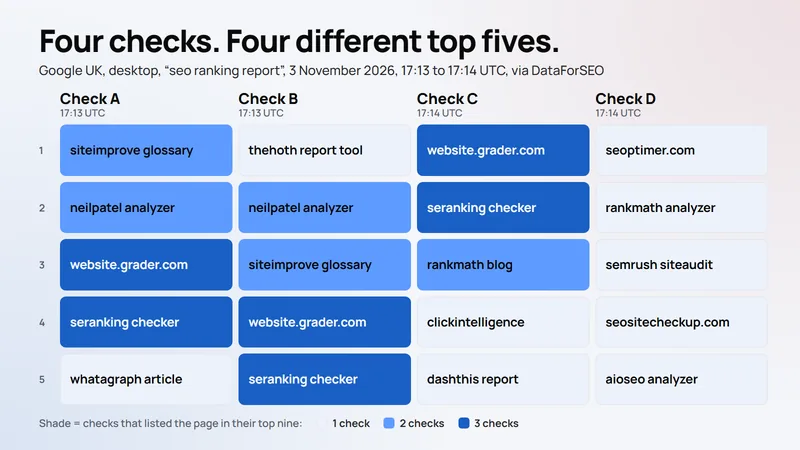
Later the same afternoon I ran this post's own target phrase four times, between 17:13 and 17:14 UTC, UK location, desktop. I got four different top fives.
No two calls shared the same five pages. Between five and seven of the nine organic links in each call were redirects.
| Rank | Check A, 17:13 | Check B, 17:13 | Check C, 17:14 | Check D, 17:14 |
|---|---|---|---|---|
| 1 | Siteimprove glossary (2) | The HOTH report tool (1) | website.grader.com (3) | SEOptimer (1) |
| 2 | Neil Patel analyzer (2) | Neil Patel analyzer (2) | SE Ranking checker (3) | Rank Math analyzer (1) |
| 3 | website.grader.com (3) | Siteimprove glossary (2) | Rank Math blog (2) | Semrush site audit (1) |
| 4 | SE Ranking checker (3) | website.grader.com (3) | Click Intelligence (1) | SEO Site Checkup (1) |
| 5 | Whatagraph article (1) | SE Ranking checker (3) | DashThis report (1) | AIOSEO analyzer (1) |
The number after each page is how many of the four checks listed it anywhere in their nine organic results. Swipe the table sideways on a phone.
Only two pages in these top fives, website.grader.com and the SE Ranking checker, appeared in three of the four calls.
These are one-afternoon observations, from one provider, so they are not independent of each other. They are not a measured rate. I do not know whether the swapping happened at DataForSEO or at Google.
What they show is how a single rank check can look fine and be wrong. Check once, and you might have been shown any of the four.
What a trustworthy SEO ranking report should show in late 2026#
Use this as a checklist.
- Device. Desktop or mobile, stated. The two differ.
- Location. The country, city or postcode area checked.
- Date and time. Not just the month. The exact check.
- Depth. How many results were requested: top 10, top 30, top 100.
- Number of runs. One check, or several at different times.
- Unresolved results labelled as unresolved. A link the tool could not identify is not "not ranking".
- Carried-forward values labelled. If a number was copied from an earlier check, it says so.
- Map pack separate from organic. The map pack is the block of local businesses with a map. It has its own position.
- AI Overview presence and citation. Does one show for the phrase, and is your site cited in it?
- Search Console comparison. Clicks and impressions for the same pages, with the break dates marked: 13 May 2025 to 27 April 2026, 28 February to 1 March 2026, 7 May 2026.
- Vendor incidents noted. A dated note beside any big change.
- Outcomes next to rank. Leads, calls or sales alongside position. A rank that rises while enquiries fall is a finding.
Questions to ask your agency or tool#
- How many times was each phrase checked, and at what times?
- Were any results unresolved or flagged as invalid, and how are they shown in my report?
- Which device and location do these positions refer to?
- Does the report show AI Overviews, and whether my site is cited?
- Have you compared the rank data with Google's own figures, allowing for the known break dates?
- If a number changed sharply, was it re-checked before it went in the report?
- What are my leads or sales doing next to these positions?
A good provider will answer these in a sentence each. If an answer is "we don't know", that is useful too.
If you want a second opinion#
I offer an Independent Rank Check for a one-off fee of £149, with no VAT added and no retainer. It is for a business that pays for SEO and wants a second opinion, or one whose traffic is falling while the report says rankings are fine.
It includes:
- up to 20 agreed search phrases, checked twice at different times, on desktop and mobile
- map pack position from 5 points across your area, for up to 5 local phrases
- whether a Google AI Overview shows for each phrase, and whether your site is cited in it
- a Search Console comparison for the same phrases and pages, if you give access to jason@jasonburns.co.uk
- a short written report that labels each phrase as a confirmed position, a likely data error or unresolved
It does not include fixing anything, ongoing tracking or link work. Anything after that is quoted separately. I will confirm the date when you book. Read the details on the Independent Rank Check page or send me your website and phrases.
Sources#
Dates are the publication or update date shown on each page, or "undated" where there is none.
- Google Search Console Help, data anomalies in Search Console (2026 entries, checked 3 November 2026)
- Google, generative AI performance reports, 3 June 2026 (checked 3 November 2026)
- Google Search Console Help, generative AI report, undated (checked 3 November 2026)
- Nozzle, poisoned Google SERPs, published 10 October 2026, updated 1 November 2026 (checked 4 November 2026)
- DataForSEO, new goto URL limits, 2 November 2026 (checked 3 November 2026)
- DataForSEO, poisoned SERPs, 23 October 2026 (checked 3 November 2026)
- Semrush, poisoned SERPs, 27 October 2026 (checked 3 November 2026)
- AccuRanker, poisoned SERPs, first published 19 October 2026, data to 25 October (checked 3 November 2026)
- SISTRIX, Google ranking data collection, 7 October 2026 (checked 3 November 2026)
- AccuRanker, num=100 update, 25 September 2025 (background, over a year old; checked 3 November 2026)
- Wincher, tracking depth limited, 18 September 2025 (background, over a year old; checked 3 November 2026)
- Moz, num=100 and changing SERP lengths, 14 October 2025 (background, over a year old; checked 3 November 2026)
- Agarwal and Sen, SSRN abstract, posted 3 April 2026 (checked 3 November 2026)
- PPC Land, report on the Agarwal and Sen study, for the sample size and data dates (checked 3 November 2026)
- Brainlabs, why organic traffic is declining, 14 September 2026 (checked 3 November 2026)
- AgencyAnalytics, 2026 agency benchmarks, survey February to April 2026 (checked 3 November 2026)
- My own observations, DataForSEO live organic checks for "nginx vulnerability" (16:26 to 16:31 UTC) and "seo ranking report" (17:13 to 17:14 UTC), 3 November 2026. Notes are not published.
Frequently asked
Why did my rankings drop for one day and then come back?
Is my agency lying to me if the report is wrong?
Why does Search Console disagree with my rank tracker?
How often should rankings be checked?
Do AI Overviews change what a ranking report means?